- Blog
- October 28, 2026
AI Compliance: Do HIPAA, GDPR and PCI DSS Apply to Your AI Prompts?
G360 Technologies

Here's a conversation we've had more than once with security and compliance leads.
"Are your teams using AI?"
"Yes, but only the approved tools. And we have a policy."
"Do you know what they're putting in the prompts?"
Long pause.
No judgment here. Almost nobody knows. And that pause is where most AI compliance problems live.
Short answer: yes, all three apply
HIPAA, GDPR and PCI DSS were written long before anyone typed "summarize this for me" into a chat box. You would think that leaves a loophole. It doesn't.
None of these rules care which tool you use. They care about the DATA. A patient record is a patient record whether it's in an email, a spreadsheet or a ChatGPT window. The obligation follows the data, every single time.
The tricky part is that a prompt does not feel like sharing data. It feels like asking a question. So people paste things into AI they would never attach to an email to a stranger. (Which, technically, is roughly what they are doing.)
HIPAA: "but it was the enterprise version"
Under HIPAA, you can only share protected health information with a vendor that has signed a business associate agreement (BAA). Consumer AI accounts don't come with one. So a clinician pasting discharge notes into a personal ChatGPT account has disclosed PHI to a third party. Good intentions don't change that.
If you think this is an edge case, it isn't. Netskope found that 88% of healthcare organizations use generative AI, and 44% of generative AI policy violations in healthcare involved regulated health data. More than two-thirds of healthcare employees using these tools send sensitive data to accounts their organization does not control.
And yes, an enterprise tool with a BAA helps a lot. It doesn't get you off the hook, though. HIPAA still expects you to share only the minimum necessary data, with only the people who need it. Healthcare lawyers are now telling clients to put AI tools in their annual HIPAA risk analysis. If yours isn't in there yet, that's a good place to start.
GDPR: regulators are not bluffing
GDPR covers any processing of personal data about people in the EU. Pasting a customer's name and complaint into an AI tool? That's processing. It needs a lawful basis, it should be limited to what's necessary, and people should know it's happening.
If anyone on your team thinks regulators won't bother with AI, here are two reasons to think again. In December 2024, Italy's data protection authority fined OpenAI €15 million over how ChatGPT handled personal data. That same month, the European Data Protection Board said AI models trained on personal data can't always be treated as anonymous.
Here's the part people miss. When your employee sends customer data to an AI tool, YOU are responsible for that processing. Not the AI vendor. "The AI did it" is not a defense anyone wants to test.
PCI DSS: the newest rulebook on the block
PCI DSS protects cardholder data wherever it's stored, processed or sent. A card number in a prompt is cardholder data being sent to a third party. Simple as that.
This one has a timely twist. Earlier this month, the PCI Security Standards Council published Security Considerations for AI Systems, and it's refreshingly direct. A few highlights:
- Use tokenized or encrypted payment data with AI wherever you can.
- If someone has tokenized data AND a way to detokenize it, treat that as access to the real data.
- Run data loss prevention independently of the AI. (Don't ask the AI to police itself.)
- Keep sensitive data and credentials out of prompts, outputs and logs.
- Get explicit human approval before an AI agent acts on cleartext card data.
It's advisory, and existing PCI DSS requirements still win. But if you want to know what your next assessor will ask about, this is a pretty good preview.
Same rules, different acronyms
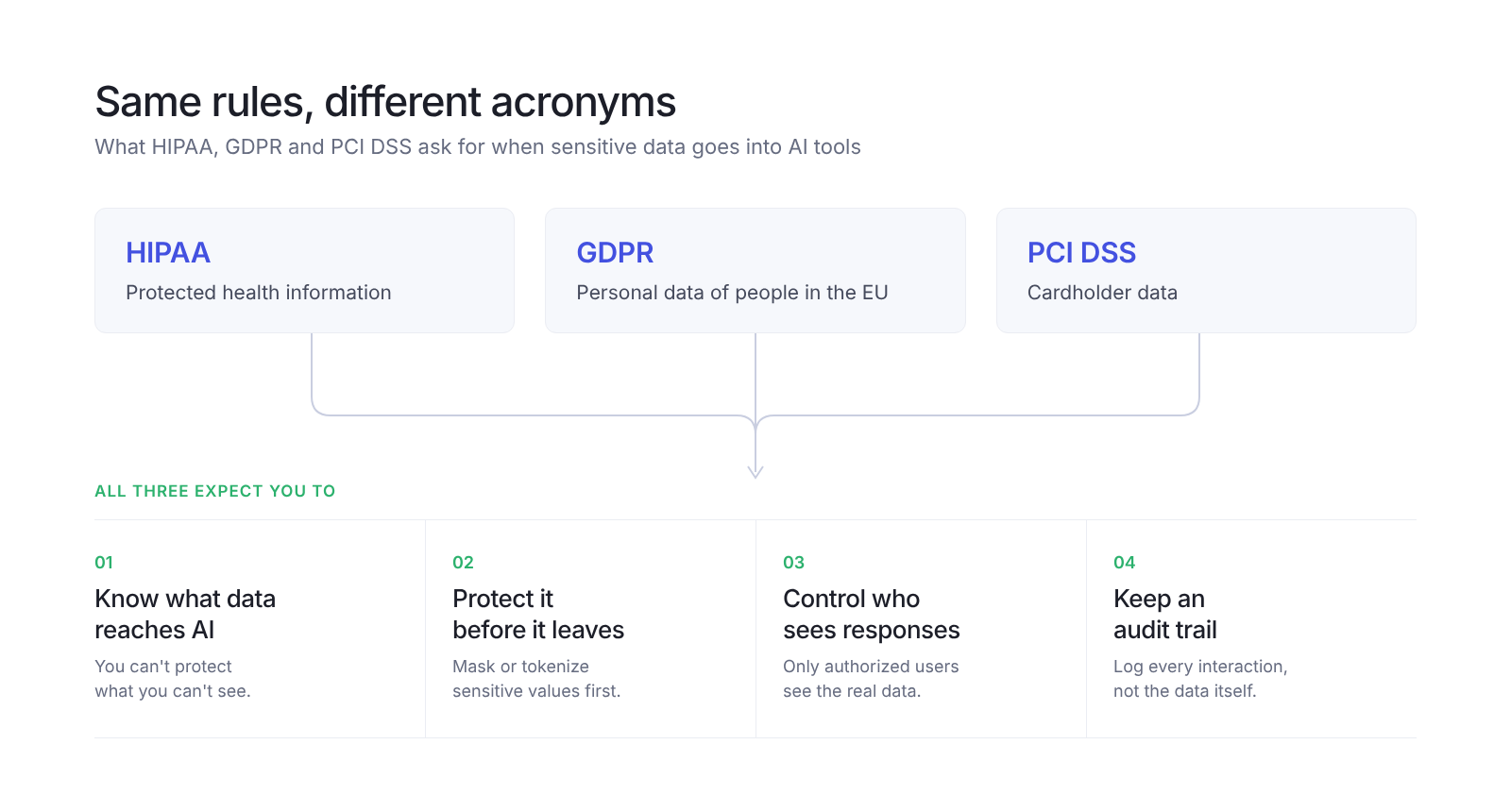
Line the three up next to each other and they're asking for the same four things:
- Know what data is going into AI. You can't protect what you can't see.
- Protect it before it leaves. Mask or tokenize sensitive values before the prompt reaches the model.
- Control who sees it on the way back. Only the right people should see the real data in a response.
- Keep receipts. Log every interaction, without storing the sensitive data itself.
You'll notice "ban AI" isn't on the list. We've written about that before: blocking AI mostly moves the same activity to personal accounts, where you have zero visibility. Not a great trade.
Where PromptVault comes in
Full disclosure: this is the part where we talk about our product. But we built PromptVault around exactly these four requirements, so it would be odd not to.
When someone sends a prompt, PromptVault spots the sensitive data (patient details, personal data, card numbers) and swaps it for secure tokens before anything reaches the model. The AI does its job with the tokens. It never sees the real values.
When the response comes back, PromptVault checks it before the user sees it. Policy-based detokenization means only people with the right permissions get the original data. Everyone else sees tokens. (We went deeper on why the response side matters in What Happens to Your Data After the AI Responds?)
Every interaction goes into an audit trail, so when compliance asks "what was shared, and by whom?", you have an actual answer. And it works across Copilot, ChatGPT, Azure OpenAI, Claude, Gemini and custom LLMs, so you're not juggling a different control for every tool.
The bottom line
Your compliance obligations didn't change when your teams started using AI. The only thing that changed is where the data goes.
Put controls on the prompt and the response, and AI stops being the thing compliance keeps saying no to. It becomes something they can actually sign off on.
Curious how that looks in practice? See how PromptVault works, or drop us a note. We're always happy to talk about this stuff.
Frequently asked questions
Is ChatGPT HIPAA compliant?
Consumer ChatGPT accounts are not covered by a business associate agreement, so they should not be used with protected health information. Enterprise AI tools with a BAA lower the risk, but HIPAA still expects only the minimum necessary data to be shared.
Does GDPR apply to data entered into AI tools?
Yes. Entering personal data about people in the EU into an AI tool is processing under GDPR. It needs a lawful basis, must be limited to what is necessary, and the company using the tool is responsible for it.
Can you use AI with cardholder data under PCI DSS?
The PCI Security Standards Council recommends using tokenized or encrypted payment data with AI wherever possible, and keeping sensitive data out of prompts, outputs and logs. Existing PCI DSS requirements still apply in full.