
It usually starts with a good decision, made for good reasons.
Someone in security reads about a company whose confidential code ended up in a chatbot. The CISO does the math on what one careless paste could cost, and on a Tuesday afternoon an email goes out: effective immediately, generative AI tools are blocked on company devices and networks.
By Wednesday, the dashboards look clean. Traffic to the big AI sites drops to almost nothing. The risk register gets an update, and everyone who signed off can say, fairly, that they did their job.
By Friday, a paralegal is drafting contract summaries on her phone.
Where the work goes when the tool disappears
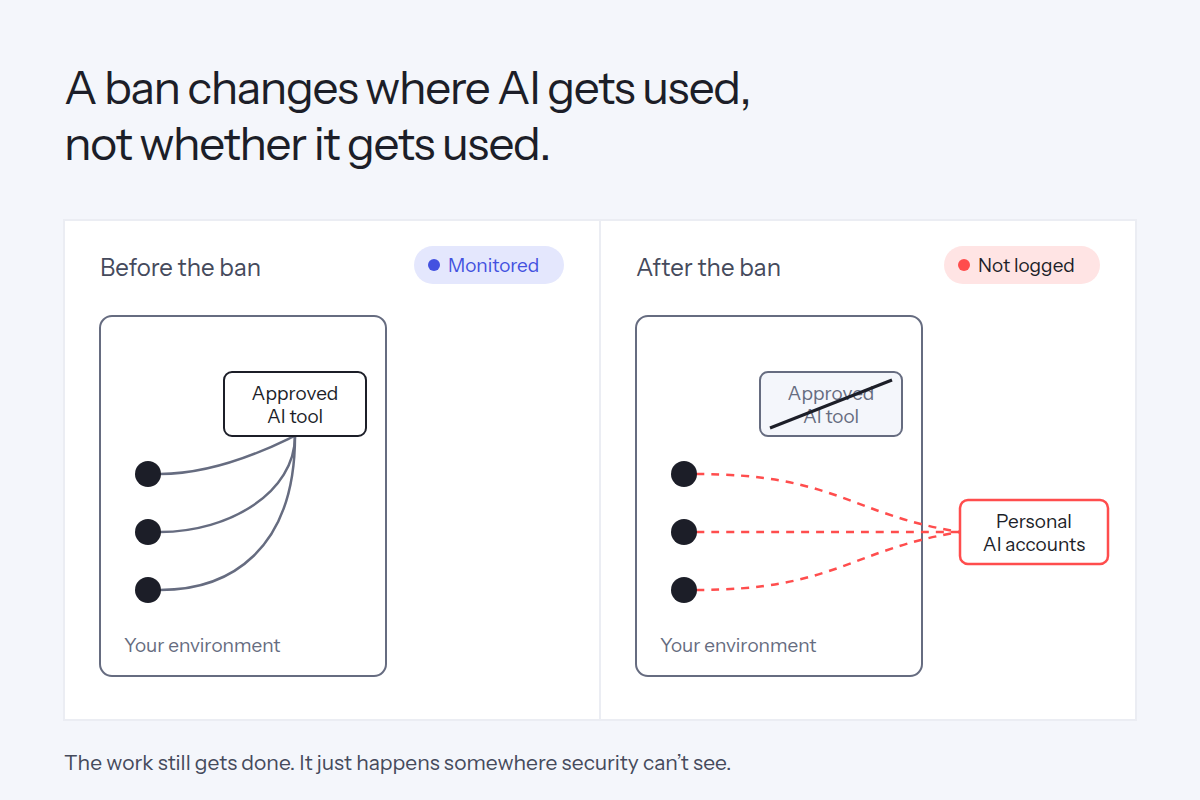
Nobody sat down and decided to break the policy. The paralegal still has forty contracts to summarize before Monday. The pressure didn't go anywhere, so the work found another route: a personal ChatGPT account, a browser extension nobody vetted, a free tool a colleague swears by.
When Gartner surveyed 302 cybersecurity leaders in 2025, 69% said they suspect or have evidence that employees are using public GenAI tools the company has prohibited.
So the ban did work, in a narrow sense. It removed AI from the places you can see. It didn't remove it from the business.
The bill arrives in three places
The cost of blocking AI rarely shows up as one big line item. It lands in three smaller places, usually owned by three different people, which is why it's so easy to miss.
The first lands on security. Every prompt that moves to a personal account is a prompt with no inspection, no log, and no way to pull it back. IBM's 2026 Cost of a Data Breach Report found that the share of breaches involving shadow AI more than doubled in a year, from 20% to 43%. More than two in three organizations still had no governance in place to manage it.
The second lands on the business. The company already paid for licenses, pilots, and training. The use cases that would have paid that back almost always involve real data: patient notes, claims files, client contracts, transaction histories. Those are precisely the ones a blanket block rules out. The spend stays on the books, and the return never shows up.
The third lands on compliance. Imagine an auditor asking a simple question: which customer data has been shared with an AI tool in the last six months? Before the ban, the honest answer might have been “some, and here's the record.” After it, the honest answer is “we don't know,” which is a much harder position to defend.
We've solved this problem before
Here's the odd thing about an AI ban. Almost every tool your company depends on can leak data. Email goes to the wrong person. A shared folder gets opened to the whole internet with one click.
We didn't ban any of them. We put controls around them. Email got data loss prevention and encryption. File sharing got permissions and access reviews. The tools stayed, and the rules about what could move through them got sharper.
AI deserves the same treatment. Whether people should use it is no longer a live question, because they already are. The useful question is whether you can control what goes into it and what comes back out.
What “yes, with conditions” looks like
In practice, it comes down to a few checkpoints on every AI interaction. Before a prompt leaves your environment, it's checked against your policies. Sensitive values like names, account numbers, or medical details are swapped for placeholder tokens, so the model can still do the job without ever seeing the real data. The response is checked before it reaches the user. And every step is logged, so the next time an auditor asks what data went where, you have an answer.
None of this requires a new rulebook. Most organizations already know which data is sensitive and who is allowed to see it. The gap is applying those rules at the moment someone hits enter.
Back to Friday
Think about that paralegal again, with her phone and her forty contracts. She was never really the risk. She was someone trying to do her job with the best tool she could find, and the policy left her two options: slow down, or go around it.
The goal isn't to catch her. It's to give her a third option, where the work gets done and the data stays where it belongs. That's a better story to tell your board than “we blocked it,” and unlike a ban, it's one you can actually prove.
That third option is what we built PromptVault to be. It puts those checkpoints in front of the model, works with the AI tools your teams already use, and runs on the data classification and access policies you already have.
If you're weighing a ban, or already living with one, we'd be glad to talk it through. Get in touch with our team and we'll show you how it would work in your environment.