
Why Isn't LLM-Level Filtering Enough to Protect Your Data?
Someone on your team probably pasted sensitive data into ChatGPT this week. Maybe it was a customer's account details, dropped in to draft a support reply faster. Maybe it was a chunk of code with an API key still sitting in it. They didn't think twice about it. And if you are being honest, you're not sure you would have caught it either.
That's not paranoia talking. Gartner's latest cybersecurity trends research found that 33% of employees admit to uploading sensitive information to AI tools their organization hasn't approved, and more than half are using personal GenAI accounts for work in the first place. IBM's most recent Cost of a Data Breach report found that when unsanctioned “shadow AI” is involved, breaches cost organizations an extra $670,000 on average, and take significantly longer to even notice.
Ask most security leaders how they're handling this, and you'll get some version of the same answer: “the AI provider filters that out, right?” It's a reasonable assumption. It's also wrong, and here's why.
Why Isn't LLM-Level Filtering Enough?
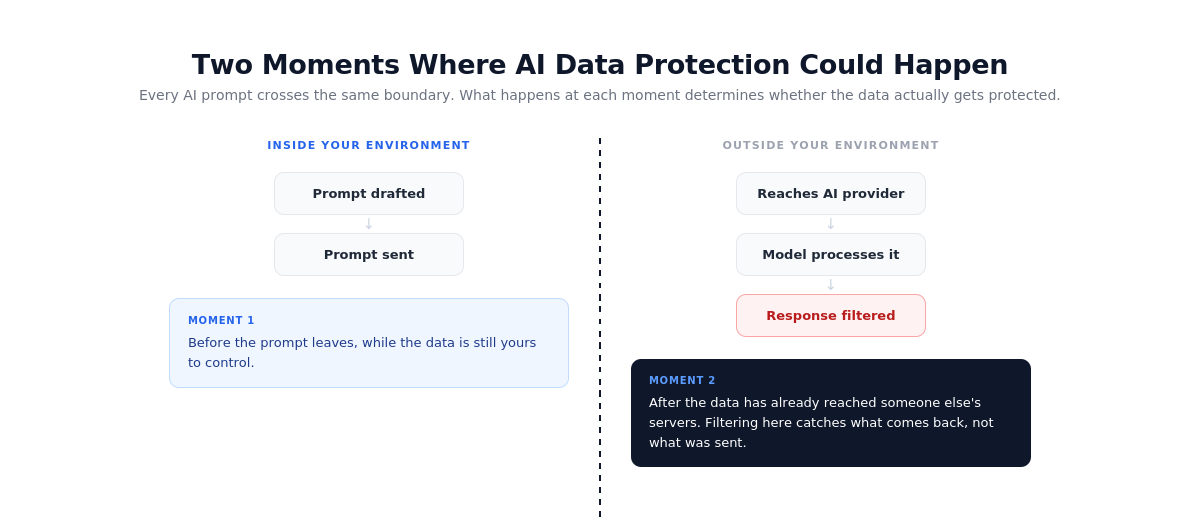
Every major LLM provider has some kind of content filter built in. But that filter only kicks in once your prompt has already reached their servers. Whatever sensitive data was in that prompt, a name, a medical record, a financial figure, has already crossed a boundary you don't control. The provider's filter can flag or block what the model says back. It can't undo what you already sent.
That's the part that gets lost in most conversations about AI safety. “Filtering” and “protecting” get used like they mean the same thing. They don't. One happens after your data is already gone. The other has to happen before.
Blocking Isn't a Strategy, It's a Workaround
The instinct to just block AI tools altogether is understandable, but it doesn't really solve anything. Gartner's own numbers show that more than half of employees are already using personal GenAI accounts for work, which usually means routing around whatever controls exist in the first place. Block the sanctioned tool, and people don't stop using AI. They just move somewhere you can't see them.
Security teams end up chasing a moving target: trying to manage the risk of AI adoption they have no visibility into, using tools that were never built to sit in front of a live prompt in the first place.
What Does Protection Before the Model Actually Look Like?
This is exactly the gap PromptVault was built to close. Instead of waiting for a filter to catch something after the fact, PromptVault inspects every outbound AI request before it reaches the model and swaps sensitive values for secure tokens in real time. The task still gets done, the model still has what it needs to give a useful answer, but the raw data itself never actually leaves your environment. Every response gets checked again on the way back, and the whole exchange gets logged, so compliance teams get a real audit trail instead of a policy document nobody's tested.
Let's Talk
The real choice enterprises are facing right now isn't “use AI” or “lock it down.” It's whether data protection kicks in before something gets exposed or after. Only one of those actually prevents anything.
We're always curious how other teams are thinking about this problem. If you're wrestling with it too, drop a comment below or reach out to us directly, we'd love to compare notes. And if you want to see how the before-the-model approach actually works in practice, contact our sales team for a quick demo.